
Love, language and connection in AAC

Being able to talk about love, in all its forms, is a fundamental part of being human. In this blog, our Clinical AAC Specialist, Becky, explores how people who use AAC can be supported to understand and express love. She looks at why love-based language matters, the role of modelling, and how access to rich vocabulary within AAC systems helps support expression, identity, and meaningful connection.
My inspiration for this blog came from a beautiful saying that was once shared with me – one I’ve since read in various places and heard others use, and one that may resonate with you too: that at the heart of connection is the ability to love and be loved.
It’s a phrase that feels lovely to read, to hear, and without doubt to experience. But it also led me to reflect: how do we ensure AAC users can explore, experience, and express connections linked to love?
When we think about the many reasons we communicate, love stands out as something we talk about, and express, in many different ways. Developing language around love, including love-based words, should be a priority for everyone. For individuals using AAC to enhance or replace natural speech, this means intentionally investing time in building understanding and ensuring their AAC system supports active participation in conversations about all kinds of love.
 The concept of love
Love doesn’t always have to be associated with romance, though of course it can be. It may also be linked to experiences, items, people, or places. As I write this, I’m reminded of Hugh Grant’s monologue in ‘Love Actually’ where he reflects that “love actually is all around” – in friendships, families, everyday moments, and small acts of care.
For some AAC users, understanding what “to love and be loved” means, and what it looks like, may be the starting point. For others, it may be about growing language to become more specific, expressive, and impactful in love-based situations that support relationships, experiences, and life choices.
From abstract to concrete
In many ways, love is an abstract concept. When learning about love, it can be helpful to make it more concrete, experiential, and supported by repeated modelling.
Some helpful questions to consider include:
How does the person currently express their understanding of love (for something, someone, or an experience)?
Can their current experiences be extended with support from the AAC tools they use?
It can also help to break the concept down using ideas the AAC user may already understand, for example:
Love = caring.
Love = liking something a lot.
Love = wanting someone to be safe and happy.
Strategies to build into everyday life
Simple, practical ways to support people who use AAC in understanding and expressing love through everyday experiences and meaningful communication.
Anchor love to real-life moments
 Anchoring the word love to real events can support understanding, such as a favourite item of clothing, a toy, or a pet. For example:
- Smiling when seeing a pet; model via AAC and spoken language: “I love (pet’s name).”
- A parent or carer gives a hug; model “I love you (name)” using AAC.
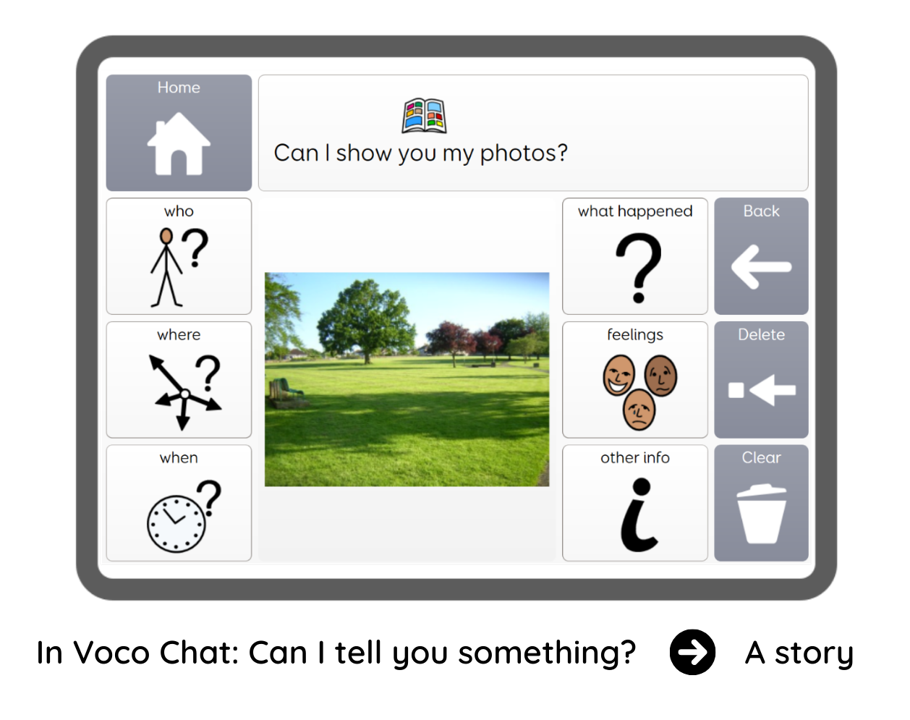
- Using photographs within AAC, for example modelling phrases like “Can I show you my photos?” in Voco Chat, to support sharing images of people, pets, places, or experiences that are meaningful or loved.
Support learning through modelling and observation
 A gentle reminder to reduce demand or expectation for AAC users to instantly express thoughts and feelings, especially when learning new or unfamiliar vocabulary. If love-based words or phrases are expressed in a way that isn’t immediately clear, acknowledge the value of the communication and respond meaningfully.
Modelling love alongside other emotionally meaningful words can also help, such as adore, amazing, the best, most excellent, or lush. Not everyone uses the word love, and another word may carry more power in a particular moment.
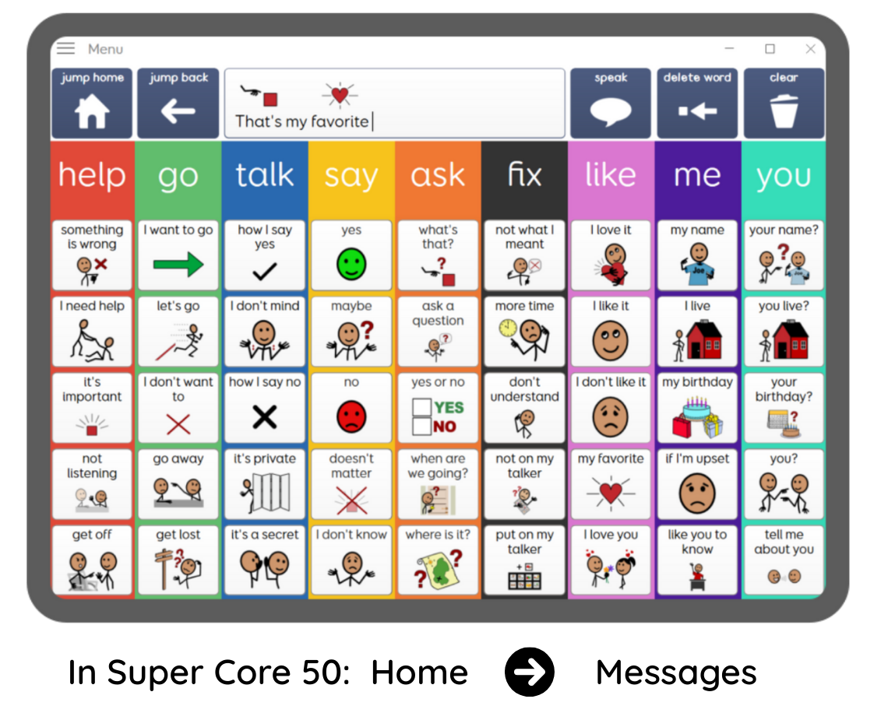
Examples include: “I love you,” “You love music,” “Do you love that?” “I absolutely adore that,” “Love, love, love it,” “That’s my favourite,” or “Grandma loves you.”
Consider where these words live within the AAC system – perhaps within a relationship-based grid set, across multiple pages, or brought together on a dedicated learning page while still encouraging exploration elsewhere.
Use contrast to clarify meaning
Understanding love can also be supported through contrast. What one person loves, another may not, and that’s okay. Exploring distinctions can help clarify meaning:
You like apples, but you love blueberries.
Feeling angry when the TV is turned off – that’s not love.
Feeling happy and excited when visiting a cousin – that can be a form of love.
This helps distinguish love from other emotional concepts such as anger or happiness.
Enhance meaning through AAC features
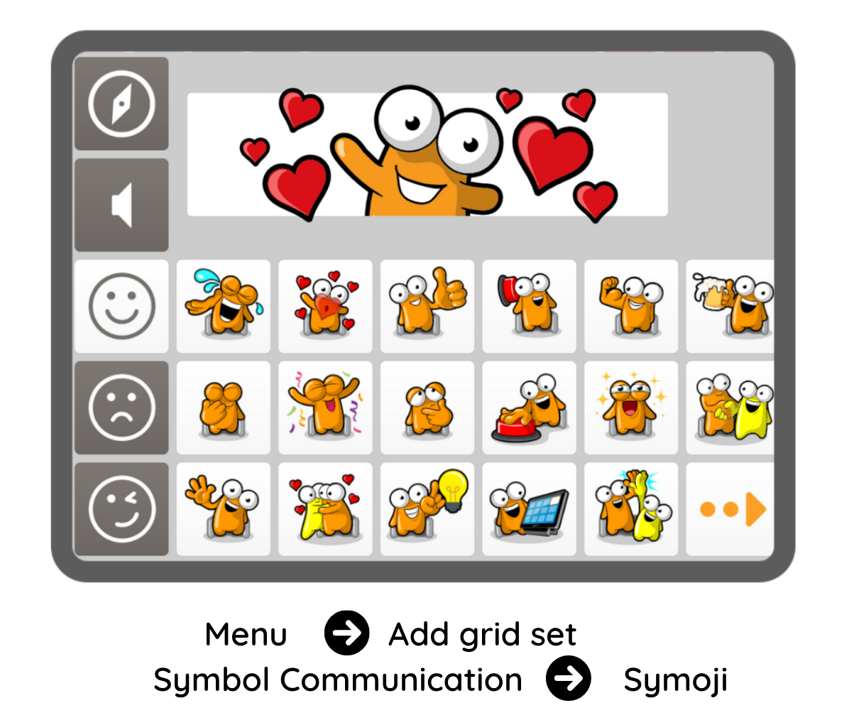 Love can be represented visually and, where possible, through sound effects. In Grid, features such as sound effects and Symoji offer expressive ways to show affection – from blowing a kiss to visual representations of love.
Text Talker allows phrases to be created and stored quickly, with prediction supporting frequently used words and phrases, ideal for AAC users who enjoy sharing and talking about what matters most to them.
Love doesn’t always need to be shown through a heart symbol or the word love. Photos of trusted people can support feelings of safety and connection. For example, in Grid, you might consider creating a page within the person’s grid set using a background image. This allows cells to appear invisible while visible buttons speak love-based statements linked to the image behind them, offering meaningful ways for feelings of love to be shared with others. There is a guide for how to do this on Smartbox Hub here.
Let AAC users define love in their own way
If love means feeling safe, calm, or wanting to be with someone, that definition is valid. Respect and validate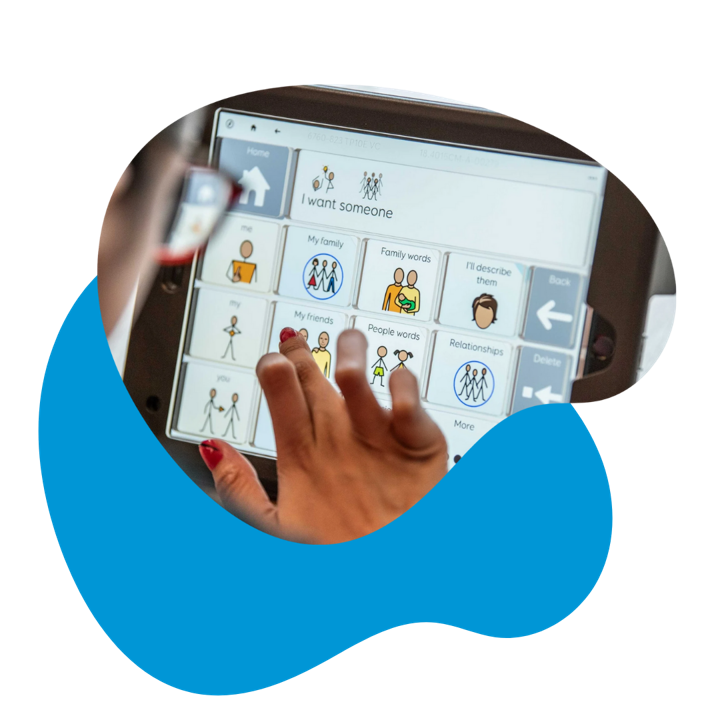 scripts where meaning feels connected to love, even if expressed differently. You can still model alternative expressions, but it’s important to begin with what matters in that moment and how the person using AAC is sharing their thoughts and feelings.
To love and be loved is not a privilege reserved for those who use oral speech – it is a human right. For people who use AAC, love may be expressed through many different avenues.
Learning and developing love-based language is most effective when it’s repeatedly linked to real actions, people, experiences, and items. When we make space for AAC users to understand love, define it, and express it on their own terms, we presume potential, honour diverse expressions, and support meaningful connections in all their forms.