
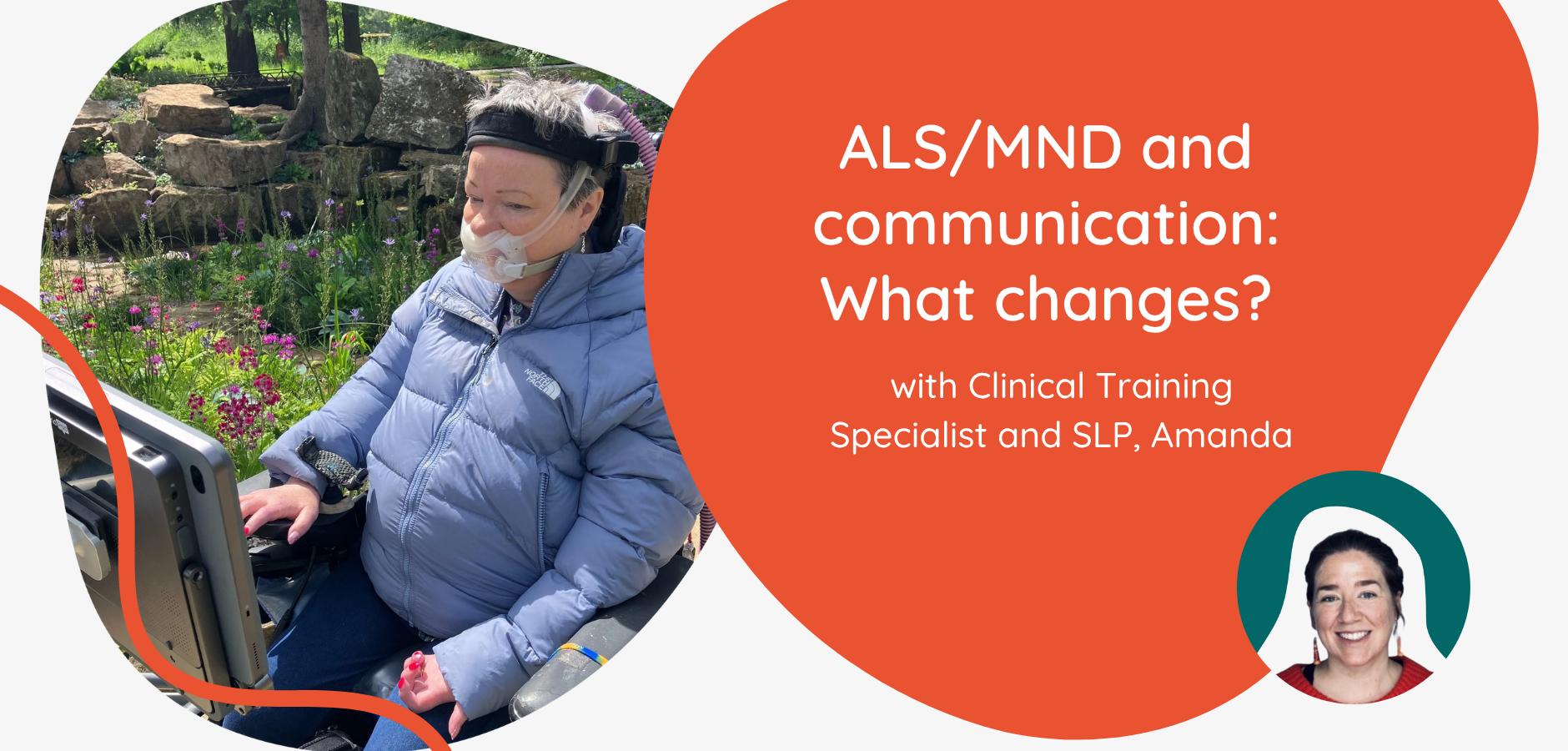
MND/ALS and AAC

Our Clinical Training Specialist (CCC-SLP), Amanda, shares her perspective on how communication changes for people living with ALS/MND, and what remains the same.
Drawing on her clinical experience, Amanda explores the role of AAC in supporting connection, identity and participation, offering practical insights into how communication can continue in meaningful ways throughout the progression of the condition.
Amyotrophic lateral sclerosis (ALS) is a form of motor neuron disease (MND), a progressive neurodegenerative disorder that affects nerve cells in the brain and spinal cord. This leads to muscle weakness and can mean loss of control over voluntary movements like walking, talking and breathing. So, it makes sense that often when people think about ALS/MND, they think about physical changes first. But one of the most significant changes people may experience is in communication.
As speech becomes more difficult, expressing thoughts, needs and personality may take more time or involve different tools. What stays the same is the need to connect, to participate and to be understood. With the right support, communication can continue in meaningful and effective ways throughout the progression of ALS, as it should.
Supporting communication as it changes
This is where Augmentative and Alternative Communication (AAC) plays an important role. AAC includes a wide range of tools and strategies that can support or replace speech as needed. These range from non-electronic options like writing, gesture or letter boards, to electronic solutions such as speech-generating devices accessed through touch, switches or eye gaze.
AAC is not a single tool or a one-time decision. It is a flexible approach, a toolkit, that can change alongside a person’s needs. Really, AAC builds on communication strategies we already use every day, ensuring the user can say what they want to say, when they want to say it.
For example, we might text instead of calling, gesture across a room or change how we speak depending on who we are talking to. AAC takes those same ideas and makes them more intentional and ensures they are accessible.
For someone living with ALS/MND, this may mean using different tools at different times, or combining methods to support effective communication across environments, communication partners and as physical abilities change.
The goal is not to replace communication, but to maintain it – clearly, consistently and in a way that reflects the individual.
Maintaining voice and identity
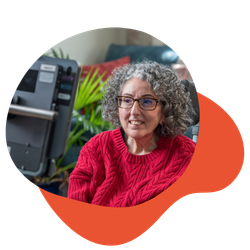
Part of ensuring an individual’s voice is heard with AAC is, quite literally, their voice. This means making sure not just that they can communicate, but how they sound when they do.
Voice is closely tied to identity. It carries tone, personality, and familiarity. Tools such as voice banking, message banking, and AI-generated voices can help support this.
- Voice banking allows someone to record their voice to create a personalised synthetic voice that can speak their messages aloud when they may no longer be able to.
- Message banking allows people to record meaningful words or phrases in their own voice that they can play with a hit of a button.
- AI voice tools can help create more natural, expressive speech.
These tools help preserve not just words, but how those words are expressed. For example, recording a message like “Do you want to go outside?” might seem simple, but the tone, emphasis and rhythm are part of what makes that message feel personal, especially perhaps, for a furry friend. And the phrase “I love you” can feel very different in a personal voice.
Supporting Communication in everyday life
Communication is a two-way street! Family members, caregivers, clinicians and beyond – all of us play a role in supporting communication.
This might look like:
- Allowing extra time for responses.
- Learning how to use AAC tools alongside the individual.
- Being flexible in how conversations happen.
- Recognizing nonverbal communication and cues.
Small adjustments can have a significant impact on how accessible communication feels.
How can you support communication?
One way to better understand AAC is to notice how you already communicate.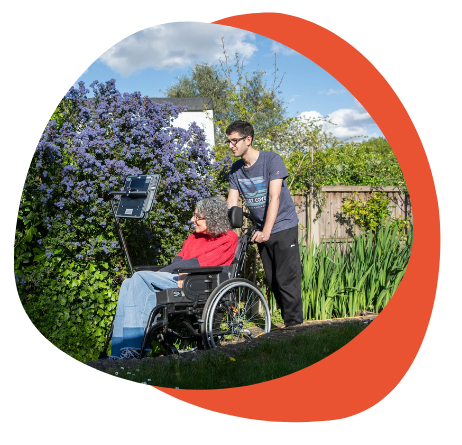
Like we’ve discussed, throughout a single day, you might:
- Send a quick text instead of speaking.
- Use a gesture instead of words.
- Change your tone depending on who you’re talking to.
- Use a completely different voice when talking to your dog.
AAC builds on these same patterns. It simply provides additional ways to support communication when it becomes more difficult.
If you’re curious, take a few minutes to explore what AAC tools can actually do. Look up a speech-generating device, watch a short demo, or browse an AAC app.
Taking away some of the unknown can make it feel less intimidating- and you might be surprised by how much is possible.
Communication continues
ALS/MND can change how communication looks, but it does not remove the need, or the ability, to communicate. AAC can reduce the impact of the changes it may bring by supporting connection, independence and identity.
In that way, communication is never lost, it just might look a little bit different.
Learn more about MND/ALS and AAC
Read Sarah’s story to learn more about her experience living with MND and using AAC, or download our Grab Guide for ALS/MND for more practical guidance, insights and links to further resources.