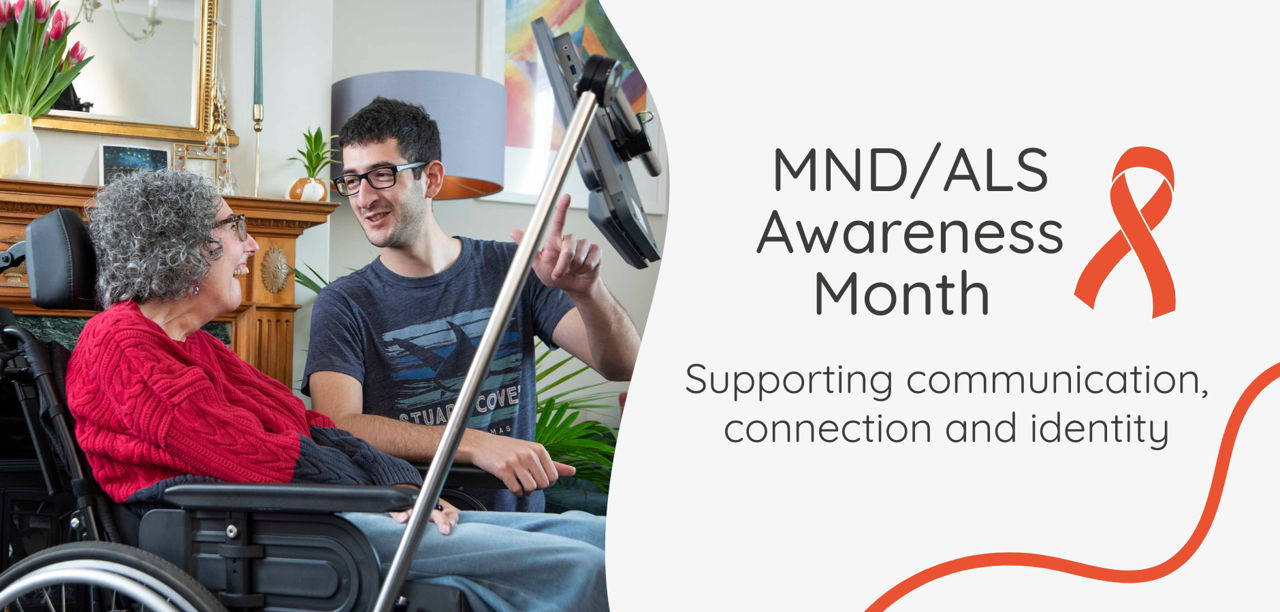
MND/ALS Awareness Month 2026
Amyotrophic Lateral Sclerosis (ALS), the most common form of motor neurone disease (MND), can affect how someone moves, speaks and interacts with the world around them.
As communication changes, many people turn to AAC (Augmentative and Alternative Communication) to support expression in ways that continue to feel natural, personal and meaningful.
We support many people living with MND/ALS across the world. This month, we’re sharing reflections from clinical practice alongside lived experiences, exploring how communication can be supported in ways that prioritise connection, identity and everyday life.
Communication is more than speech
Communication is not just about speaking. It’s about staying connected, sharing thoughts and feelings, and continuing to take part in the moments that matter.
It’s how we build relationships, express who we are, and feel part of the world around us. Whether it’s joining in a conversation, sharing a joke, asking a question, or simply being present in a moment – communication is at the heart of everyday life.
AAC can support this in many ways, from messaging and using social media to creative expression and conversation. It offers different ways to communicate that can adapt to the individual, helping people connect, participate and express themselves.
Reflections from our Clinical Training Specialist, Amanda
From clinical experience, there are still common misunderstandings around AAC and MND/ALS. Amanda (CCC-SLP) from our US team, shares that in practice:
- Introducing AAC earlier can support confidence and familiarity.
- There is no single way to access communication; different methods can support different needs.
- Communication is not limited to speech; it includes texting, writing, creating and connecting.
AAC is not one tool or one approach. It is about finding what works for the person and supporting communication in ways that feel right for them.
Amanda will be sharing more clinical insights this month – stay tuned for her blog.
Meet Cath
Cath is a Grid Pad 13 user living with MND, who uses eye gaze and a personalised voice to communicate. She uses her device throughout the day – from staying in touch with family and friends to browsing the internet and expressing her creativity. Using her Grid Pad, she communicates much like she would on a phone, and has even gone on to create artwork and fundraising projects, raising over £5,000 for the MND Association and designing a charity shirt for Leeds Rhinos. Her advice is simple:
.png) “My advice to others with MND is to bank your voice as soon as possible to retain your original sound and accent. It’s so much easier now. The ElevenLabs voice is as close to your original voice as I think you can get. It really sounds like me!”
“My advice to others with MND is to bank your voice as soon as possible to retain your original sound and accent. It’s so much easier now. The ElevenLabs voice is as close to your original voice as I think you can get. It really sounds like me!”
Cath, Grid user living with MND
Meet Sarah Ezekiel
Sarah Ezekiel is an internationally recognised eye gaze artist and advocate living with MND. After losing access to speech and movement, it wasn’t until she received assistive technology in 2005 that she was able to reconnect with the world around her.
Since then, Sarah has used eye gaze technology to create digital art, exhibit internationally, and direct creative projects, including Ms MaNDy’s Adventures in Wonderland, a multimedia theatre production exploring disability, identity and expression through storytelling, music and AI visuals.
For Sarah, communication and creativity are deeply connected. Losing her voice was one of the most difficult parts of living with MND.
“Losing my speech was the most difficult part of living with MND. I felt.png) like I had lost my identity. With just a single line of speech from an old video, ElevenLabs were able to recreate my voice using AI. I love having my voice back, I almost cried when I first heard it. My kids couldn’t remember what my voice used to sound like, but now they can hear the real me again.”
like I had lost my identity. With just a single line of speech from an old video, ElevenLabs were able to recreate my voice using AI. I love having my voice back, I almost cried when I first heard it. My kids couldn’t remember what my voice used to sound like, but now they can hear the real me again.”
Sarah Ezekiel, Grid user living with MND
Her advice to others is simple: “With good technology and support, anything and everything is possible.”
Voice and identity
For many people, voice is closely tied to identity. Advances in voice technology are making it possible to create voices that feel more natural and personal – supporting people to communicate in ways that reflect who they are.
Through our partnership with the ElevenLabs Impact Program, Grid users can access more authentic-sounding voices that better reflect their unique personality, community, and identity.
Communication doesn’t stop with speech, and neither should it. For people living with MND/ALS, AAC can enable connection, creativity, independence and identity. Most importantly, it allows people to express themselves in ways that feel like them.
This MND/ALS Awareness Month, we’ll be sharing more about how AAC can support communication, alongside reflections from practice and lived experiences. Follow along to learn more.