Recognising International Day of Persons with Disabilities
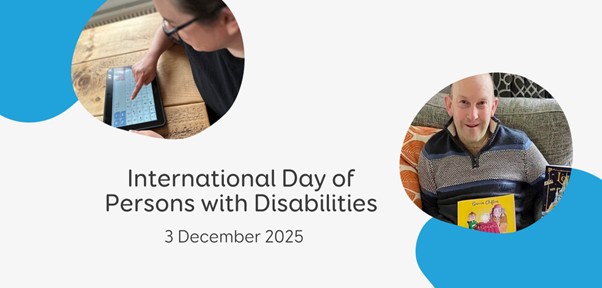
Every year on 3 December, the world marks International Day of Persons with Disabilities (IDPWD) – a day to recognise the rights, dignity and contributions of people with disability, and to reflect on how far we still need to go to achieve true inclusion.
Every year on 3 December, the world marks International Day of Persons with Disabilities (IDPWD) – a day to recognise the rights, dignity and contributions of people with disability, and to reflect on how far we still need to go to achieve true inclusion.
At Smartbox, this day sits at the heart of our mission – to create AAC technology so that everyone has the freedom to communicate, connect and be heard. We believe that communication should never be the reason someone is left out of a conversation, a classroom, a decision, or a moment that matters.
IDPWD is a reminder that accessibility is not a ‘nice to have,’ it’s essential.
Why IDPWD matters to us
For many of the people we support, Augmentative and Alternative Communication (AAC) is one part of life with a disability.
AAC might help someone:
- Take part in a conversation with friends.
- Ask questions in a hospital appointment.
- Participate in school or work.
- Share their personality, humour, and opinions.
But accessibility goes beyond communication. It’s also about transport, attitudes, architecture, policies, funding systems, and everyday interactions – all of the things that either open doors or quietly close them.
On IDPWD, we want to:
- Highlight how AAC and assistive technology can reduce barriers.
- Acknowledge where barriers still exist – in systems, environments and attitudes.
- Celebrate the creativity, resilience and expertise of people with disability.
In the words of Alex and Gavin
Each year, instead of speaking about disability from a distance, we want to amplify the voices of people with lived experience. We invited Alex and Gavin, two people who live with disabilities and use AAC, to share their perspectives and insights in their own words.
Meet Alex
Alex is someone whose story highlights the importance of communication in all its forms. Born with autism and living with epilepsy, she’s spent her life finding ways to connect with the world around her. But instead of relying solely on speech, Alex uses AAC such as Makaton symbols and her Grid Pad device, to help express herself. These tools are more than just communication aids; they are her bridge to independence, work, friendships, and everyday life.
.png) “I wish that other people understood that a voice doesn’t need to be verbal. You don’t just have to listen with your ears. You can listen with your eyes too. Disability for me, a lot of the time means anxiety, but it shouldn’t mean that. It shouldn’t mean anything. We are all unique and all individuals. Awareness is knowing differences exist. Acceptance is believing it belongs. But belonging is where the magic happens. When disabled people belong, when they’re understood, valued and included – they don’t just survive, they flourish and thrive. My one hope, wish and dream, is that everybody is enabled to have a voice so that the world can see who they really are – funny, intelligent, cheeky, playful, caring and loving.”
“I wish that other people understood that a voice doesn’t need to be verbal. You don’t just have to listen with your ears. You can listen with your eyes too. Disability for me, a lot of the time means anxiety, but it shouldn’t mean that. It shouldn’t mean anything. We are all unique and all individuals. Awareness is knowing differences exist. Acceptance is believing it belongs. But belonging is where the magic happens. When disabled people belong, when they’re understood, valued and included – they don’t just survive, they flourish and thrive. My one hope, wish and dream, is that everybody is enabled to have a voice so that the world can see who they really are – funny, intelligent, cheeky, playful, caring and loving.”
Alex, Grid user
Alex has also created a video, sharing her journey with AAC and how we can all support in helping to create a more inclusive world.
Meet Gavin
Gavin is a bestselling children’s author, creative writer, and disability awareness speaker who has been on a lifelong journey with AAC. First introduced to AAC in primary school, he went from feeling frustrated by communication barriers to using AAC as a tool for independence and success. Today, it enables him to share his story, advocate for disability awareness, and inspire others through his writing and public speaking.
Through his books and advocacy, Gavin challenges misconceptions about disability and highlights the many ways people communicate. He dreams of publishing a children’s book that teaches young readers about AAC, gestures, and facial expressions, helping to foster understanding and inclusion from an early age.
.png) “The magic of visibility. It opens up conversations and conversations break down barriers. And when people see me, a bloke with cerebral palsy who writes books, writes lyrics, and somehow manages to make sarcasm work though a robot voice, or now an AI voice – it challenges what they thought disability looked like. It chips away at the awkwardness, at the underrepresented expectations. And I’ve done events, radio interviews, been on BBC Wales Today, even spoken at the Senedd (Welsh Parliament). And none of that was about being a token. It was about being real and showing that disabled people don’t belong in the background.”
“The magic of visibility. It opens up conversations and conversations break down barriers. And when people see me, a bloke with cerebral palsy who writes books, writes lyrics, and somehow manages to make sarcasm work though a robot voice, or now an AI voice – it challenges what they thought disability looked like. It chips away at the awkwardness, at the underrepresented expectations. And I’ve done events, radio interviews, been on BBC Wales Today, even spoken at the Senedd (Welsh Parliament). And none of that was about being a token. It was about being real and showing that disabled people don’t belong in the background.”
Gavin
Gavin also shared the following:
“Having a disability isn’t the be all and end all of who we are. It’s part of us. It shapes how we move, how we speak, how the world sees us sometimes. But it’s not who we are. We’re defined by what we do with the cards we’ve been dealt, the strength we build, the walls we knock down, and the absolute refusal to sit back and accept other people’s low expectations.
Here’s what I’ll leave you with. Always back yourself, no matter what. Let your quirks and colours show. They’re what make you, you. Don’t judge what you don’t understand. Ask, learn, be better. And if you’re going to be an ally to the disability community, be a proper one. That means listening, speaking up, and never doing it for the credit. If we want a world that actually works for everyone, it starts with awareness, then comes action, then comes change.
Be patient, that’s the biggest one. Don’t jump to finish sentences, and don’t assume we’ve got nothing to say just because we take a bit longer to say it. Talk to us, nod around us. If you’re with someone who uses AAC, give them the time and respect you’d give anyone else. It’s easy to look at the person next to them for a response, but that takes away their voice, literally.
Ask how we prefer to communicate. Everyone’s different. Some AAC users like to use pre-programmed phrases, some like to type everything out, some might want support with navigating certain settings. Don’t guess, please ask.
And finally, don’t make it a big deal. AAC is a communication tool, not a spectacle. Treat it as normal, because for us, it is normal. Being a good ally means creating space for us to speak and actually listening when we do.”
Through his writing, Gavin challenges perceptions, sparks conversations, and highlights the strength and beauty in diversity. His autobiography, Cerebral Palsy & Me, shares his personal journey, while his latest children’s book, Max and the Magic Wish, brings his message of kindness and inclusion to young readers everywhere.
Recognising IDPWD, Gavin has also just launched a new children’s book, Anya and the Enchanted Wheelchair. Check it out here.
You can also follow Gavin on Instagram, Facebook and LinkedIn.
Beyond one day
For us, IDPWD is not a standalone day. It’s part of a much bigger commitment to:
- Make AAC visible and available everywhere it’s needed.
- Work with partners and teams around the world to adapt to local systems and realities.
- Learn from the people who use AAC and let their experiences shape our decisions.
We’re proud to work alongside people who use AAC, families, clinicians, educators and disability organisations in many countries, and we know there is always more to do.
Because IDPWD is about more than awareness. It’s about listening, changing, and building a world where everyone can take part; a world where no one is left without a voice.