
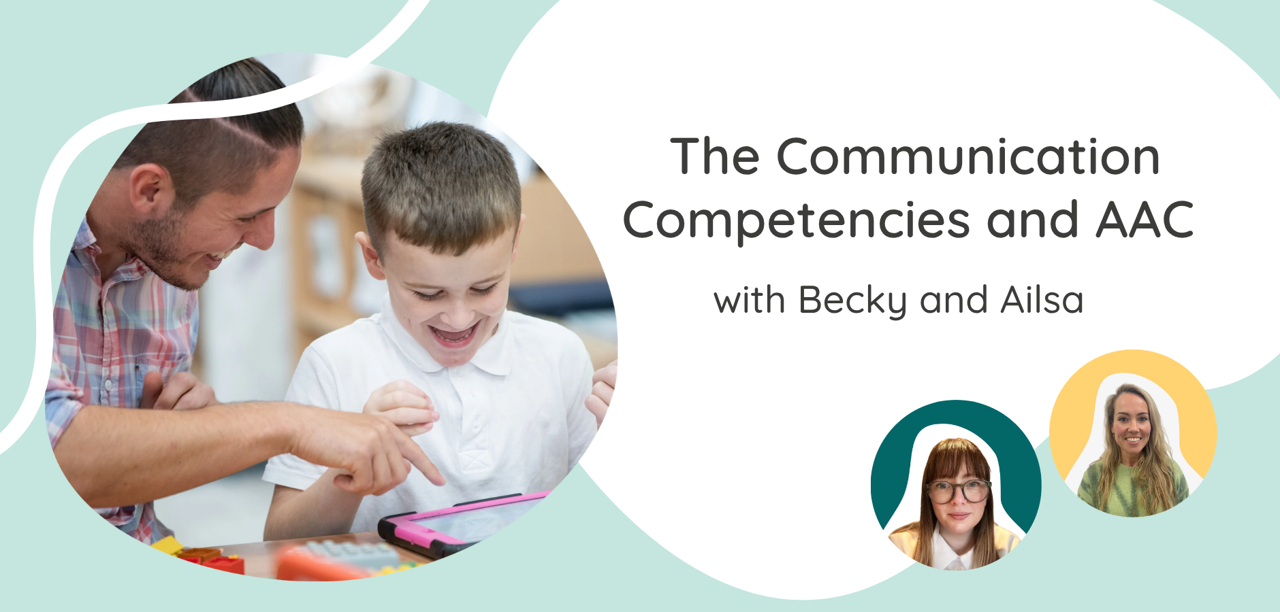
Getting started with Communication Competencies and AAC
 The communication competencies have influenced clinical practice for decades, yet they can be sometimes be unfamiliar to someone new to the AAC community. Our Clinical AAC Specialists, Becky and Ailsa, introduce the framework and share why they believe it’s valuable for anyone supporting people who use AAC.
.
The Communication Competencies for AAC have shaped both of our clinical practice for many years, yet they’re often misunderstood or overlooked.
In this blog, we’ll explore what the Competencies are, where they came from, and why they’ve remained such an important framework in AAC for more than three decades. Along the way, we’ll share some of the insights we’ve gained through our own experiences and challenge a few common misconceptions.
In part two, we’ll take a closer look at each competency and bring them to life through practical examples and stories from AAC users.

Where did the Communication Competencies come from?
The concept of Communicative Competence was first introduced by Dr Janice Light in 1989. Her work fundamentally changed the way many people approached AAC.
Rather than measuring success by vocabulary size, accuracy or technical skill alone, she proposed something much broader:
Supporting people to become competent communicators in ways that are meaningful to them.
She identified four key areas of communicative competence:
- Linguistic Competence – understanding and using language.
- Operational Competence – being able to access and operate an AAC system.
- Social Competence – building relationships and participating socially.
- Strategic Competence – solving communication challenges when they arise.
Later research also recognised the importance of psychosocial factors, including motivation, confidence, resilience and attitude, as well as the growing recognition of emotional competence.
Together, these areas provide a wonderfully holistic picture of communication.
As Janice Light and David McNaughton wrote:
“The technology is only a tool; it is the people and the interaction between them that must be our main focus.”
That quote still resonates with us today.
Before Smartbox
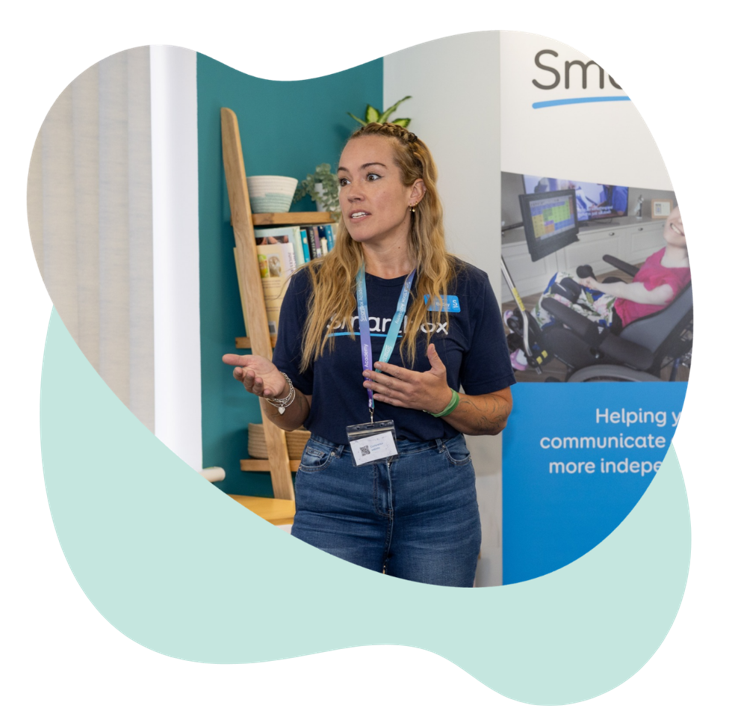
Long before we joined Smartbox, the Competencies were already a big part of both of our clinical practice.
Like many clinicians, we used them to help guide assessment, intervention and goal setting. Over time though, the way we drew upon them evolved. Rather than simply using them as a framework for supporting AAC users, they became a way of thinking – helping us focus on the whole person rather than simply the communication system they were using.
Since joining Smartbox, that perspective has only grown. Although our roles now look very different, we still find ourselves returning to the competencies time and time again. In fact, they’ve become something of a checklist that helps us reflect on projects, conversations and product development.
They're not just for clinicians
One of the biggest things we’ve realised is that the Competencies aren’t only useful for Speech and Language Therapists.
Every week we work alongside colleagues across Hardware, Software, User Experience (UX), Research and Development, Marketing, Training and many other teams, and sharing the competencies has helped build a broader understanding of what successful AAC really looks like. Because communication isn’t supported by one profession; it’s influenced by thoughtful hardware design, intuitive software, accessible content, meaningful training, supportive communication partners and so much more.
The same is true for parents, carers, educators and people who use AAC themselves. If AAC is already part of your everyday life, chances are you’re already seeing the competencies in action, whether that’s supporting someone to make choices, explore their device, build confidence, connect with others or advocate for themselves. You may not know them by name, but the competencies provide a helpful way of recognising, celebrating and building on the communication skills that are already developing.
Understanding the competencies helps us all ask slightly different questions:
How easy is this device to access?
Can someone express their personality?
Does this feature support confidence?
Are we creating opportunities for communication, rather than simply providing technology?
Those conversations make our products stronger and ultimately benefit the people who use them.
 It's about outcomes not tools
This is something we’re particularly passionate about at Smartbox. AAC isn’t about the technology itself; it’s about what the technology enables someone to do.
- Can they tell a joke?
- Can they order their favourite meal?
- Can they tell someone they don’t agree?
- Can they join in with family conversations?
- Can they advocate for themselves?
Those are the outcomes that matter.
The Competencies remind us to keep coming back to the person and what they want to achieve, rather than becoming overly focused on the tool they’re using.
They're not an exclusive club
Perhaps the biggest misconception we come across is that the Competencies are only relevant once someone is using a robust language system or has developed literacy skills.
They aren’t.
The Competencies aren’t reserved for experienced AAC users, nor are they tied to one communication system or vocabulary package.
Every form of AAC is valid. Whether someone communicates using objects, symbols, photographs, paper-based communication books, switches, eye gaze or text-based systems, the competencies still apply.
Equally, someone doesn’t need to “master” one competency before beginning another. Communication develops in lots of different ways, often all at once. That means we can start noticing strengths, identifying opportunities and supporting growth immediately – wherever someone is on their AAC journey.

A framework, not a checklist
It’s easy to look at the Competencies and wonder where to
begin. Many people naturally focus on linguistic competence, because vocabulary often feels like the most obvious place to start.
Vocabulary is incredibly important, but communication is much bigger than words alone.
Sometimes the biggest gains come from supporting confidence. Sometimes it’s making a device easier to access. Sometimes it’s helping someone understand how to repair a conversation when communication breaks down. Sometimes it’s simply creating more opportunities to communicate throughout the day.
The Competencies encourage us to step back and ask: What matters most to this person right now?
That shift can make intervention feel much more achievable and meaningful.
They can be useful for everyone
Even if you never formally use the Communication Competencies in your work, they’re a brilliant reflection tool. Over the years they’ve become something we regularly come back to, whether we’re reviewing a product feature, planning training, preparing a presentation or thinking about someone’s communication journey.
They help us celebrate strengths rather than focusing on what’s missing. They remind us that communication is about people. And they encourage us to keep asking how we can create more opportunities for individuals to express themselves in ways that matter to them.
Looking ahead
This blog is just the beginning. In part two, we’ll explore each competency in more detail, share practical examples from real-life clinical practice and hear directly from AAC users about what communicative competence means to them.
Until then, we’d encourage you to reflect on one simple question:
If communication is the essence of human life, what could we do today to help someone communicate just a little more confidently tomorrow?
Let's keep the conversation going
How have the Communication Competencies influenced your thinking or practice? Share your perspective with us on our Facebook, Instagram, or LinkedIn.
References