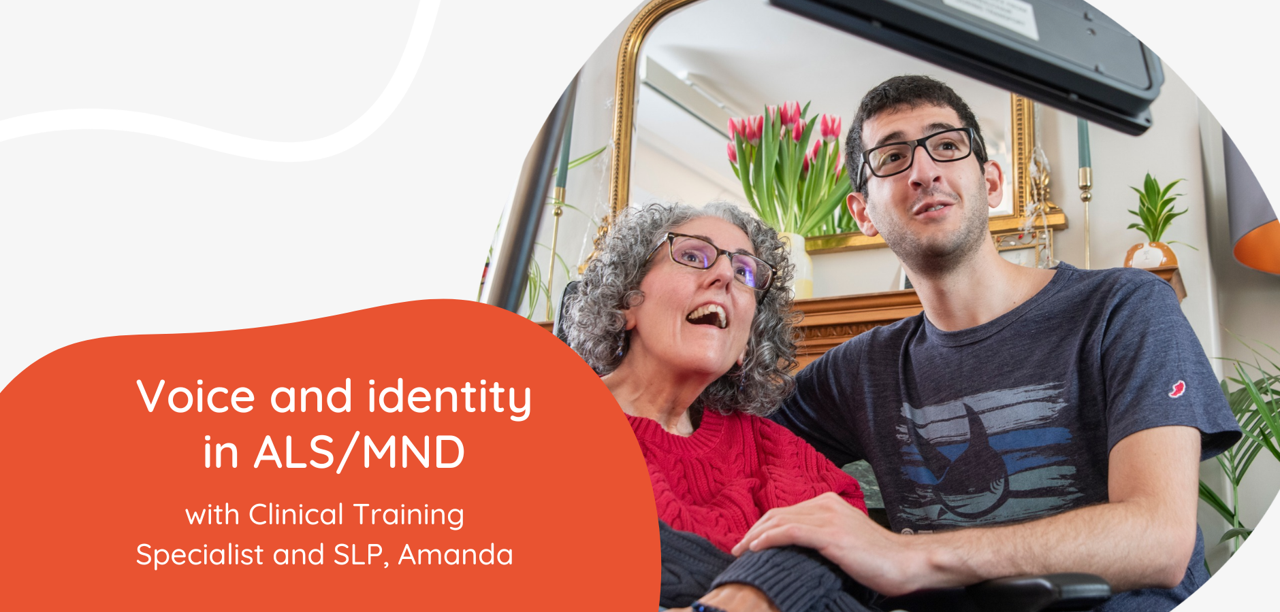
Voice and Identity in MND/ALS
As part of ALS/MND Awareness Month, our Clinical Training Specialist (CCC-SLP), Amanda, explores the role of
voice in communication and identity.
She shares insights into voice banking, message banking, and the evolving options available, highlighting how people can continue to express themselves in ways that feel personal and meaningful.
Early in my career, I recognized the importance of voice banking, but if I’m honest, at that time, it could often feel a little disappointing.
It mattered deeply, and it absolutely made (and still makes) a difference in someone’s quality of life. But some of the earlier options could require recording well over a thousand sentences, sometimes six to eight hours or more spread across multiple sessions, and the resulting synthetic voice did not always capture what made someone’s voice feel familiar or personal.
The positive news is that things have changed! The improvements in voice banking technology over the last decade have been astounding. With advances in technology, what once felt like a labor-intensive, almost niche option has evolved into a landscape of meaningful choices.
Our voices carry humor, identity, relationships, timing, personality, and so much more. They hold the way someone says a partner’s name, tells a favorite story, comforts a child, or lands a joke exactly right.
Even people who say they “don’t like the sound of their own voice” often feel differently when they face potentially losing it or already have.
Voice banking and message banking: what’s the difference?
People often hear these terms together, but they are different, and that difference can be important when making
choices.
Voice banking typically means recording speech to create a personalized synthetic voice that can late
r be used with AAC or a speech-generating device. With that voice, a person can continue generating new messages, typing whatever they want to say in a voice modeled after their own.
Message banking is different. It involves recording messages or words in your natural voice. Things like short phrases, signature expressions, laughter, names, jokes, stories, “I love you,” even reading a favorite book aloud for a grandchild. Those recordings can later be played back exactly as recorded with the press of a button, and can be just as meaningful, maybe more in some ways, as synthesized speech.
While both are valuable options independently, the most powerful approach is often a combination of voice banking and message banking together.
More options, and more choices
One of the biggest changes in recent years is not simply that technology has improved, but there are now a growing number of pathways available.
Some voice banking approaches may involve a longer recording process, sometimes requiring many sentences recorded over multiple sessions, but perhaps resulting in the voice someone is dreaming of. Others can require much less time and may be more feasible for someone wanting a simpler process or who is beginning later.
Some voices are designed to be stored and used locally within communication systems, while some newer AI-supported approaches may rely on cloud-based tools or offer different workflows. The point is not that one option is better than another; it’s that there are options.
Different tools may fit different priorities. Time, cost, energy, desired voice quality, access to recordings, technology preferences, or where someone is in their communication journey, can all be factors in deciding which voice banking or message banking tool is right for them.
It can also help to know that voice banking companies and speech-generating device (SGD) companies are separate entities. Voice banking services help create or preserve the voice itself, while AAC or SGD systems provide communication tools where that voice may be used.
That distinction matters because wanting a particular SGD does not automatically lock someone into one voice banking path. In many cases, there is flexibility, which can create more options. It is still worth cross-checking compatibility, but many major AAC systems work with widely used voice banking services.
Earlier is still better
One thing has not changed since my early days working in the world of voice preservation: earlier planning often opens more possibilities. For people with ALS/MND, beginning conversations about voice and message banking early, before speech changes, can help preserve the strongest possible recordings and create more choices over time.
But it is also important to say this clearly: It is rarely too late to ask what options remain. Some services now offer forms of voice repair, using older recordings or smaller speech samples to help reconstruct aspects of a person’s voice, even when traditional voice banking was not completed early. Additionally, there are ways for people to donate voices or combine and ‘boost’ what recordings someone may have to create a dynamic synthetic voice.
Not just for MND or ALS
While these conversations often come up during ALS Awareness Month, these tools matter far beyond ALS, across diagnoses, ages, and AAC communities. At their heart, they are about preserving something deeply personal: the sense of being present in your relationships, of being recognized in the way you sound, and of being heard in a voice that feels like your own, whether that voice is one you preserve, one rebuilt, or one you come to make your own. And that is worth protecting.
Learn more about voice and AAC
Explore the voices options available in our Grid AAC software, or download our Grab Guide for MND/ALS for more practical guidance, insights and links to further resources.