
The AAC Communication Competencies in action
 The four communication competencies provide a helpful framework, but what do they look like in everyday life? Our Clinical AAC Specialist and SLT, Becky, explores each one through the experiences of AAC users Jamie, Ellise and Elijah, showing how communicative competence develops in different ways for different people.
In our previous blog, we introduced the four AAC Communication Competencies and explored why they’re such an important way of understanding communication beyond vocabulary and language alone.
This time, with the help of three AAC users, we’re sharing real examples of how these competencies show up in everyday life. Because communicative competence doesn’t look the same for everyone – and that’s exactly the point.
Before we begin, it’s worth remembering that communicative competence isn’t something someone achieves on their own. As Janice Light and David McNaughton (2014) remind us, communicative competence is shaped not only by the skills of the AAC user, but also by the support, understanding and confidence of the people around them.
That’s why it’s so important to recognise that growth/progress/success mean different things to different people, and to recognise that every person’s communication journey is unique.
A reminder of the four competencies
The four AAC Communicative Competencies, first described by Janice Light (1989), are:
- Operational
- Linguistic
- Social
- Strategic
It’s important to remember that communicative competence isn’t about mastering every competency. It’s about developing enough skills across these areas to communicate meaningfully, and that will look different for every AAC user.
Meet our contributors
Every AAC journey is different. Jamie, Ellise and Elijah all use AAC, but their experiences, communication styles and goals highlight the four competencies in different ways:
Jamie is a stand-up comedian, AAC advocate and service user representative from Yorkshire who has cerebral palsy. He has used AAC for the past 14 years and communicates using vocalisations, his Grid Pad, and support from his partner, Emma, who revoices for him.
Ellise has cerebral palsy and uses a Grid Pad with eye gaze. Alongside being an AAC Ambassador, she is a motivational speaker, EDI Ambassador at Ashton Park School, a Trustee at Teach Us Too, and Disabilities Editor and Patron for the Jill Dando News Centre.
Elijah is a five-year-old autistic AAC user. He began communicating with Grid for iPad before transitioning to a Grid Pad Go. His mum, Haley, shares their family’s journey online, celebrating his communication, learning and everyday achievements.
Operational competency
Operational competence is about being able to access and use an AAC system effectively. This includes everything from navigating between pages and finding vocabulary, to understanding device features and using different access methods such as eye gaze, switches or joysticks. As someone’s communication needs change throughout the day, so too might the way they access their device.

Jamie's story
Jamie uses a Grid Pad 15 with a combination of text and symbol vocabulary. Depending on where he is and what he’s doing, he switches between different access methods. At home, he prefers using a Praetorian joystick while sitting in his armchair. In his wheelchair, he relies on dwell access, and when performing comedy or giving talks, he uses a foot switch to control Document Reader so he can deliver each punchline with perfect timing.
Strategic competency
Communication doesn’t always go to plan. Strategic competence is about finding other ways to get your message across when something is missing, misunderstood or doesn’t quite work. That might mean rephrasing, using gestures, facial expressions or pointing, or combining different communication methods to help others understand what you’re trying to say.
 Ellise’s story
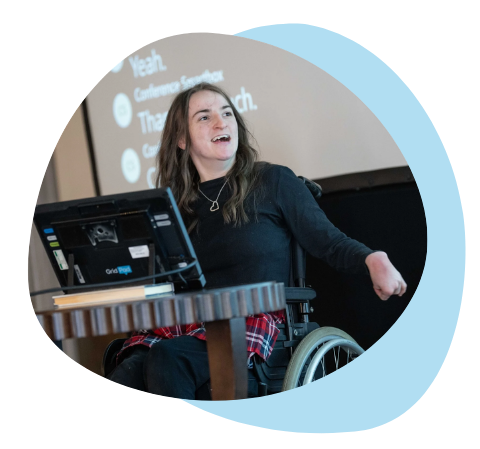
Ellise has cerebral palsy and today, uses her Grid Pad with eye gaze to communicate. Reflecting on her early experiences with AAC, Ellise remembers not always having the words or phrases she needed: “I used lots of hand gestures, facial expressions, sounds and eye pointing.”
These strategies helped her continue communicating while her AAC toolkit evolved, reminding us that every form of communication has value.
Elijah’s story
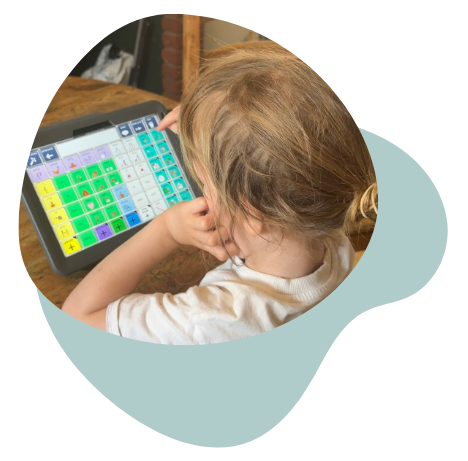
Elijah is autistic and uses his Grid Pad Go to communicate. His mum, Hayley, shared another lovely example of strategic communication.
When Elijah feels upset or thinks people aren’t listening, he asks for his “Tap” (AAC device). He knows it helps him communicate more clearly and gives him another way to express what’s bothering him.
She also remembers an early moment in his AAC journey when he discovered just how powerful his device could be. One evening, after being told there wasn’t any ice cream at home, Elijah selected: “Ice cream. Car. Shop.”
It was the first time he’d independently combined words to communicate such a clear idea. “So yes,” Hayley laughs, “I did put him in the car and drive to the shop at 7pm on a school night.”
It’s a story that perfectly captures strategic competence in action – using AAC to solve a problem and communicate a message in a new way.
Linguistic competency
Linguistic competence is about using language to express ideas, thoughts and feelings. It includes knowing where vocabulary is stored, combining words into meaningful messages and developing language over time.
 Ellise’s story
Looking back, Ellise remembers a time when her communication was much more limited: “I think I used to use only specific words rather than typing out sentences. For example, if I wanted a drink, I would have just said ‘drink’.”
Today, Ellise primarily uses Text Talker to generate spontaneous messages, allowing her to communicate exactly what she’s thinking and feeling.
With access to the right tools, Ellise’s communication evolved beyond meeting immediate needs to expressing her personality, preferences and identity. As her language grew, so did her ability to choose words that felt authentically hers, enabling richer, more meaningful conversations.
Elijah’s story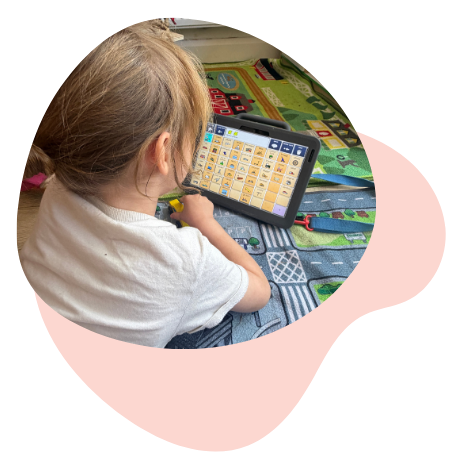
For Elijah, linguistic growth is showing up in exciting new ways. His mum, Hayley, recently shared that he has started spontaneously combining words such as: “Now fire. Next fire truck.”
While it might seem like a simple phrase, it demonstrates something much bigger. Elijah is beginning to understand sequence, cause and effect, and how words like now and next can help organise events and experiences. It’s a wonderful example of language developing through everyday interactions.
Social competency
Communication is about so much more than making requests. Social competence is about connecting with other people – joining conversations, sharing jokes, asking questions, telling stories, building friendships and expressing personality.
Ellise’s story
Looking back on her school years, Ellise reflects on how her communication changed over time: “At primary school my communication was quite limited, but when I went to secondary school it expanded so much.” As her communication developed, so did her ability to chat with friends about everyday life, not just communicate her needs.
For Ellise, having the right communication tools meant she could participate more fully in conversations and share more of who she is.
Elijah’s story
One of Elijah’s favourite features in Grid is Symoji. He loves creating funny messages like: “Stinky bum!” “Stinky feet!” “Fast car, fast police car… crash!” (followed by an enthusiastic “Oh no!”). He’s even started sharing these jokes with his classmates, using humour to initiate conversations in ways he hadn’t before.
Hayley has also noticed him beginning to use spoken phrases socially. One morning, he woke her up by saying: “You look nice.”
“It came from somewhere,” she says, “but he’s realised it’s something you can say that makes people happy.”
These moments remind us that communication isn’t only about making requests. It’s about connecting with people, making them laugh, sharing kindness and letting your personality shine through.
The competencies work together
The stories shared by Jamie, Ellise and Elijah remind us that there is no single path to becoming a confident communicator. Every AAC user develops and demonstrates the communicative competencies in their own way.
Rather than focusing on what someone can’t do, the competencies encourage us to recognise strengths, celebrate what progress means to an individual and create more opportunities for meaningful communication every day.
Every conversation helps build understanding of AAC
If you think this blog could be useful to someone you know or work with, we’d love you to share it with your network.