
Using Smart Prompt to expand vocabulary
From generating message options in real time to helping users express humour, frustration, and everyday stories, Artificial Intelligence (AI) -powered features are beginning to change what participation in conversation can look like for AAC users.

In this blog, Speech and Language Pathologist Brenda Del Monte shares her experience introducing the Smart
Prompt powered Expand tool in Grid, with Trinity Joy, an AAC user.
Brenda reflects on what happened when a single word, and then a few more, opened the door to something much bigger.
Using the Expand tool with Trinity Joy
.png)
Using the Expand tool with Trinity Joy
I walked in, and Trinity Joy immediately said: “IV Surgery Don’t Want.”
Then she continued: “IV. IV. IV. IV.”
I have known Trinity Joy for years, but I have never been her ongoing speech-language pathologist. Recently, I added Smart Prompt’s AI tools to her Grid Pad and returned to see how she was using them. I knew enough about Trinity Joy to begin co-constructing the conversation she had initiated.
“Uh-oh,” I said. “So, you need a surgery and you don’t want it because you hate IVs? Am I close?” She nodded yes. Her mom filled me in on the possible upcoming surgery. As Trinity Joy continued repeating “IV” in the background, I asked, “I wonder if the Expand tool would give you options for talking about this?”
She said “yes” and navigated to her AI tools page.
She entered “IV” and selected Expand.
Nothing particularly meaningful appeared.
And honestly, that was exactly the lesson.
One of the most important concepts in communication is that meaning is rarely carried by words alone. Communication is co-constructed between people. We rely on shared experiences, background knowledge, context, facial expressions, timing, relationships, and countless other pieces of information that exist beyond the words themselves.
Researchers have long described language as a socially constructed process, with meaning emerging through interaction rather than existing solely within an individual’s message (Vygotsky, 1978; Bruner, 1983).
So, I turned to Trinity Joy and said:
“I bet you can say ‘IV’ to your mom, and that’s enough for her to sit down and have a conversation with you about needles, surgery, fear, anxiety, frustration, sadness – all of it.”
Her mom didn’t need a paragraph. She needed two letters.
I continued: “And I love that one word can begin a conversation about something so personal and scary.”
With me, Trinity Joy knew she needed to provide a little more information.
She had given me: “IV. Surgery. Don’t want.” Because I knew her history, I could infer that she hadn’t recently had surgery and that she was likely talking about something upcoming. Together, we were able to co-construct a conversation around important news she wanted to share.
The Expand tool, however, knew none of that.
Teaching the Expand tool what matters
When we entered only “IV,” the AI system didn’t know enough about Trinity Joy or her situation to expand accurately. We needed to provide more information.
When we entered:
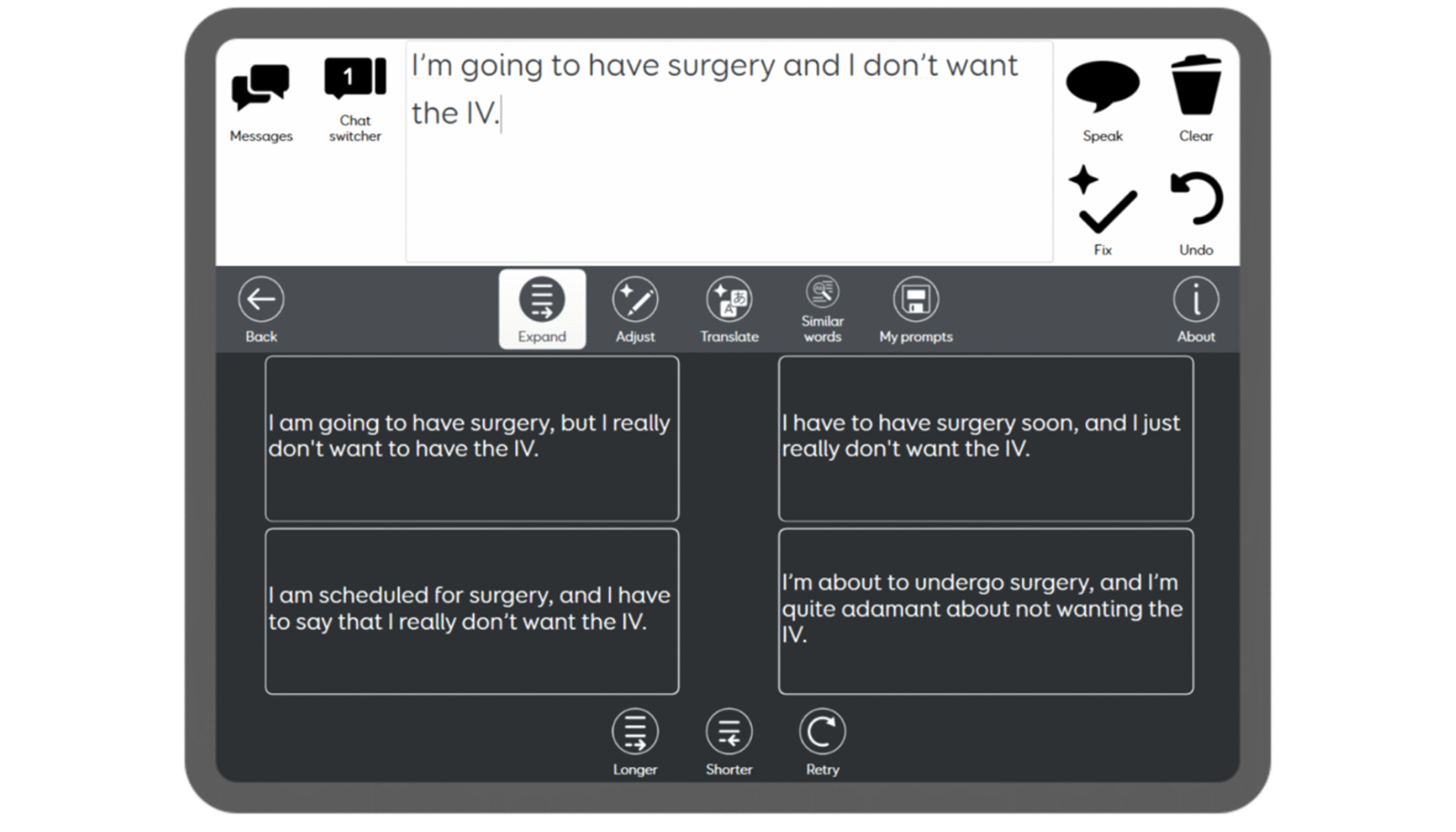
“IV surgery don’t want” the tool assumed the event had already happened and generated responses in the past tense.
We then used the Future tool to shift the message to: “I’m going to have surgery and I don’t want the IV.”
Suddenly, the output became more relevant.
This became an opportunity to discuss something larger than AI. We talked about how we communicate with people who don’t already know us.
How do we tell a doctor who doesn’t know our history?
How do we communicate with someone who doesn’t know when the surgery is?
How do we explain the meaning behind two simple letters – IV – when they represent fear, uncertainty, and worry?
The tool wasn’t replacing communication. It was helping Trinity Joy practice providing enough context so that someone unfamiliar with her could join the conversation.
Expanding participation
I asked Trinity Joy if she would like the Expand tool added to her health page so she could use it during medical appointments.
She lit up.
Together, we practiced giving the tool enough information to generate options that could help her communicate with doctors and other unfamiliar communication partners.
Then I asked if there were any other pages where she wanted the tool available.
Without hesitation, she requested an “Expand with teenage language” button on her social page.
The following week, I returned to hear story after story about how the Expand tool was helping her stay in conversations. Not conversations later. Conversations in real time.
Research consistently demonstrates that AAC users often face significant barriers to conversational participation because message generation is slower than natural speech (Light & McNaughton, 2014). By helping users quickly generate language options that can then be accepted, rejected, revised, or personalized, AI-supported tools may help reduce some of these participation barriers.
One story stood out.
An aide had taken Trinity Joy through a drive-through and told her she could order a protein box and a lemonade. Later, the aide decided the lemonade contained too much sugar and ordered water instead. By the time Trinity Joy arrived at occupational therapy, she was still thinking about it.
She entered: “[Aide’s name] sugar no lemonade”
The Expand tool generated several responses, including:
“What is a girl gotta do to get a lemonade around here?”
and
“I know you care about the sugar, but I don’t.”
Everyone laughed.
Including Trinity Joy.
Especially Trinity Joy.
Because it was exactly how she felt.
In the past, she might have dropped the topic entirely. She might have stayed frustrated or sad. She might have waited until she got home and repeated “no lemonade” until someone pieced together the story.
This time she participated in the moment.
This time she got to share the joke.
This time she got to be heard.
Finding her voice
Her mother was nearly in tears as she described the impact.
Historically, a new device would create excitement for a few weeks before eventually becoming what she called “a box of words”, used primarily for anticipated needs.
.png)
But human beings are motivated by more than requesting.
We are driven by social connection.
We comment.
We tease.
We complain.
We tell stories.
We share worries.
We express opinions.
The Expand tool brought renewed interest in Trinity Joy’s device because it supported the things she most wanted to talk about.
She now comments on things she observes and overhears. She talks about birthdays that are still months away. When she used Expand with Teenage Language about her birthday, one option read: “Mark your calendars – my birthday is in August, and in case you’re wondering, it’s on a Tuesday.”
Perfect. The tool didn’t create her personality. It revealed it.
Preserving authorship
Perhaps most importantly, Trinity Joy remains in control. She is still considered an emergent reader and writer. She listens to every generated option before making a selection. If none of the options fit, she can hit Retry.
She can adjust the emotion.
She can change the tense.
She can reject every suggestion.
She can choose none of them.
And when a generated phrase perfectly captures what she wants to say, she can save it for future use. Authorship is not determined by who generated the first draft of a sentence. Authorship is determined by who decides whether that sentence reflects their intended message. The communicator remains the author when they select, reject, revise, and direct the final message.
A call to reconsider waiting
So, before we do what we have always done –
Wait until we know for sure they understand.
Wait until we know for sure they meant what they said.
Wait until we know they can read.
Wait until we know they can spell.
Wait until we know they are ready for text-based tools.
Let’s consider the least dangerous assumption.
What if they are smarter than we know?
What if they are capable of more than we presume?
What if they are fully capable of recognizing their own voice when they hear it?
And what if our role is not to be gatekeepers deciding when they are ready – but gate openers creating opportunities for them to show us who they have been all along?
References
Bruner, J. (1983). Child’s Talk: Learning to Use Language. Oxford University Press.
Light, J., & McNaughton, D. (2014). Communicative competence for individuals who require augmentative and alternative communication: A new definition for a new era of communication? Augmentative and Alternative Communication, 30(1), 1–18.
Vygotsky, L. S. (1978). Mind in Society: The Development of Higher Psychological Processes. Harvard University Press.
How to try Smart Prompt
Smart Prompt helps you create your own AI powered tools in Grid. This blog provides some tips on how you can get started with this online AI tool.
.png)
Expand tool
blog we look at the Expand tool.
Rethinking language access in AAC
Brenda Del Monte, MA, CCC-SLP, explores some of the ways new technology like AI, might prompt us to rethink how language is accessed in AAC. Read more.
.png)
Supporting voice and choice
Explore how a User First approach can help clinicians guide the safe, informed, and ethical use of AI in AAC. Learn more.